
Uncategorised
Why Use Motorcycle Transporters for Track Days?
Oct
Your first lap at Aragón, Portimão or Mugello should begin with tyre warmers humming in the paddock, not with a tired body, a road-grimed bike and 1,000-plus miles already behind you. That is why use motorcycle transporters is a question serious UK track riders ask before every European booking. The right transport operation does not merely move your motorcycle. It protects your track time, your energy and the headspace you need to ride faster.
A European circuit trip is not a casual weekend away. It is a chance to chase braking markers, work on body position and put meaningful laps on the board at world-class tracks. Motorcycle transport gives that mission the preparation it deserves.
Why use motorcycle transporters for European track days?
The obvious answer is convenience, but that barely scratches the surface. Riding or driving your bike across Europe can be part of the adventure, and for some riders it is exactly the right call. If you are planning a road trip, carrying minimal kit and have time to spare, the journey can be brilliant.
A multi-day circuit event is different. You are travelling with a machine prepared for hard use, often a second set of wheels, tyre warmers, stands, leathers, tools, spares and the usual paddock essentials. You also need to manage crossings, fuel, overnight stops, tolls, secure parking, fatigue and the possibility of a mechanical problem before the event has even started.
Professional motorcycle transport strips that friction out of the plan. Your bike goes from a UK collection point, or is collected from your door where available, and arrives in the paddock ready for you to take over. You can fly out fresh, collect your kit and get focused on the job ahead.
That matters on day one. The first session is where you reacquaint yourself with the circuit, build tyre temperature and establish your references. Starting that process rested and composed is a genuine performance advantage, not a luxury.
Save your energy for the circuit, not the motorway
Long-distance riding asks plenty of you. Hours in the saddle, changing weather, unfamiliar roads and the concentration of crossing several countries all add up. Even when the journey goes perfectly, it takes a toll. Arrive late, sleep poorly or carry stiffness into the morning and your early sessions become recovery laps.
Transport lets you separate travel from riding. You can take a direct flight, arrive with enough time to eat properly, walk the paddock and check the bike before briefing. Instead of rolling through the gates wondering whether the rear tyre survived the autoroute, you can check pressures, set your sag and concentrate on your first apex.
It also makes the return journey more sensible. After several hard days on circuit, riders are often physically and mentally spent. The bike may have fresh slicks, worn consumables or battle scars from an intense week. Handing it back to the transporter means you are not facing a punishing ride home when your focus should be on recovering and reviewing what you learned.
Your bike travels as track equipment, not luggage
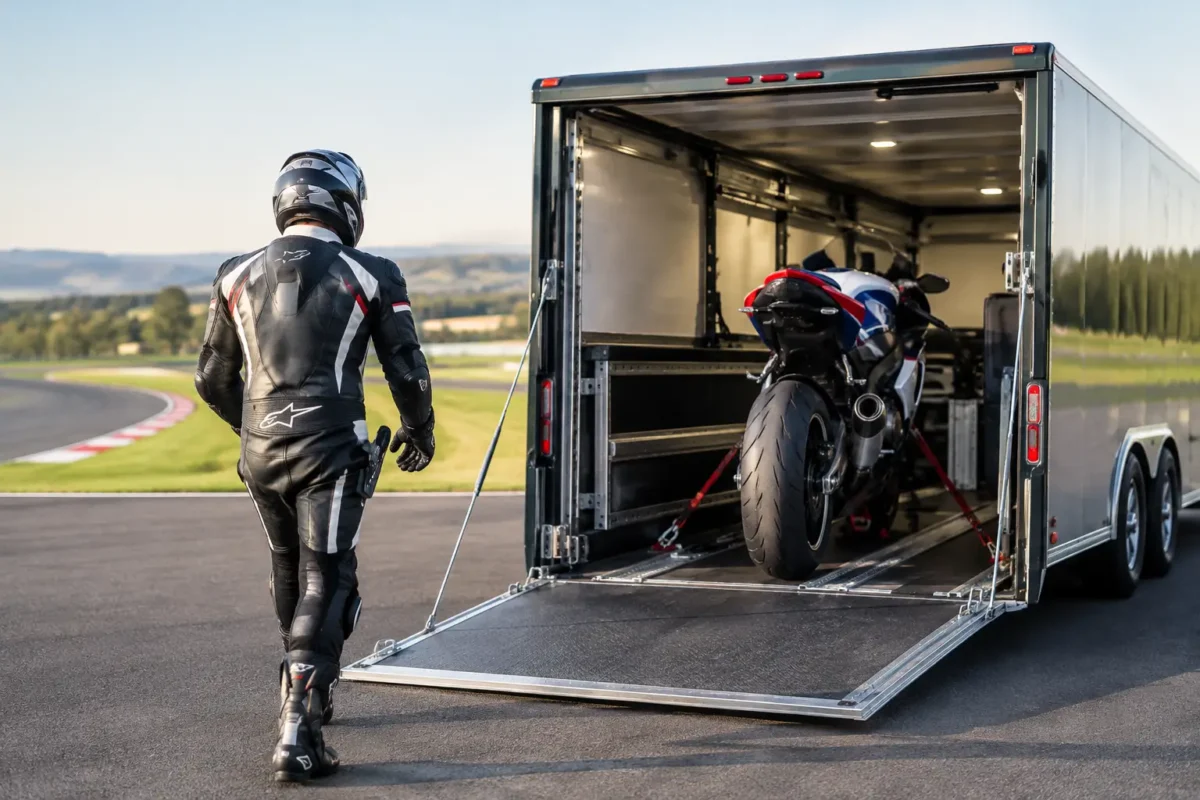
Not all motorcycle transport is equal. A bike intended for performance riding needs to be secured properly, handled by people who understand motorcycles and carried in equipment designed for the task.
A quality operation uses purpose-built stillages that hold the motorcycle securely and upright, without relying on improvised straps pulling aggressively on the suspension. The bike should be stable through loading, transit and unloading, with clear processes at every handover. That reduces the risk of damaged bodywork, bent levers, stressed fork seals or the nightmare scenario of discovering avoidable transport damage at the circuit.
Ask how motorcycles are loaded, what is included with the transport and how collection and return are managed. It is also worth checking what kit can travel with the bike. A helmet, leathers and basic paddock equipment are not afterthoughts on a track day. They are part of your operating system.
The cheapest quote is not always the best value. Saving a little money means nothing if poor handling costs you a day of riding, a replacement part or confidence in the machine beneath you.
It makes bigger circuits feel closer
Spain, Portugal, Italy and the rest of Europe offer circuits that are difficult to replicate in the UK. They also sit far enough away that the road journey can become the dominant part of the trip. Transport changes the calculation.
Suddenly, a long weekend at a premier circuit is about the circuit itself. You can use limited annual leave more intelligently, arrive for the event rather than days before it, and return without turning the trip into a logistical endurance test. That opens the door to riding more of the tracks that genuinely move your development forward.
For riders who want to improve, repetition matters. So does riding varied layouts and learning to adapt to elevation changes, blind entries, long-radius corners and high-speed braking zones. Transport makes those opportunities more accessible without demanding that every event becomes a two-week expedition.
More room for the kit that keeps you riding
Track riders rarely travel light. There is the obvious kit – leathers, helmet, boots and gloves – then the practical gear: stands, warmers, generator, tools, torque wrench, spares, fuel cans where permitted, canopy and chairs. Add wet-weather options, hydration, cameras and a spare visor, and the packing list grows quickly.
Trying to carry everything on the bike can force compromises. Taking a car and trailer solves some problems, but creates others: ferry timings, trailer security, motorway restrictions, extra fuel use, storage and the added fatigue of towing across Europe.
With a transporter, you can make more deliberate choices about what supports your riding. Bring the tools that let you react to a loose lever or a worn pad. Take the spare wheels that save a session when weather changes. Pack properly for the paddock rather than hoping everything fits around a set of bungee cords.
There are limits, of course. Every operator has rules around weight, dimensions, loose items and prohibited materials. Treat those rules seriously. Clear labelling, a sensible inventory and secure packing make collection quicker and protect everyone’s equipment.
Less paperwork pressure, more control
Cross-border motorcycle travel comes with administration, particularly when your bike is leaving the UK temporarily for an event. Documents, vehicle details, customs arrangements and timing all matter. Missing or incorrect paperwork can turn a straightforward plan into a stressful delay.
A specialist provider cannot remove your responsibility to give accurate information, but it can organise the process around the reality of track-day travel. Support with ATA Carnet administration and clear pre-event communication give riders a far stronger position than trying to decipher every requirement alone at the last minute.
This is where experience counts. A transport team familiar with European paddocks, collection schedules and event timings knows that a vague answer is not good enough. You need to know where your bike is going, when it must be ready, what you need to do and who will answer if plans change.
At Race Shift, transport is built around the event experience rather than treated as an add-on. The aim is simple: your motorcycle, kit and paperwork should arrive in a position that lets you get on with riding.
The trade-off: cost versus the value of your track time
Motorcycle transport has a price, and it will not suit every trip or every budget. Riders with a van, plenty of time and a preference for travelling under their own steam may choose to drive. There is nothing wrong with that. The journey can be part of the story.
But assess the full cost, not just the transport fee. Include fuel, tolls, crossings, hotels, food, parking, wear on the bike or towing vehicle, and the value of extra days away from work or family. Then factor in the quality of the riding you are likely to do after a demanding journey.
For a rider investing in several days of circuit time, tyres, coaching and accommodation, arriving fresh can be the difference between circulating and progressing. Professional transport protects the expensive part of the trip: the time at full throttle.
Choose a transporter like you choose a track-day organiser
Look for evidence of a process, not just a promise. Clear collection locations, realistic deadlines, specialist stillages, defined kit allowances and responsive communication all signal that the operation is built for riders. Ask what happens if there is a delay, how bikes are checked in and out, and what support is available around the event.
You also want a team that understands the paddock. A motorcycle is not a parcel, and a track rider is not simply a passenger with luggage. The details matter because the details are what keep your weekend moving when the schedule is tight.
Your bike should arrive ready to work. You should arrive ready to ride. Put your energy into the next braking marker, the cleaner exit and the lap time waiting on the other side of the chequered flag.
